
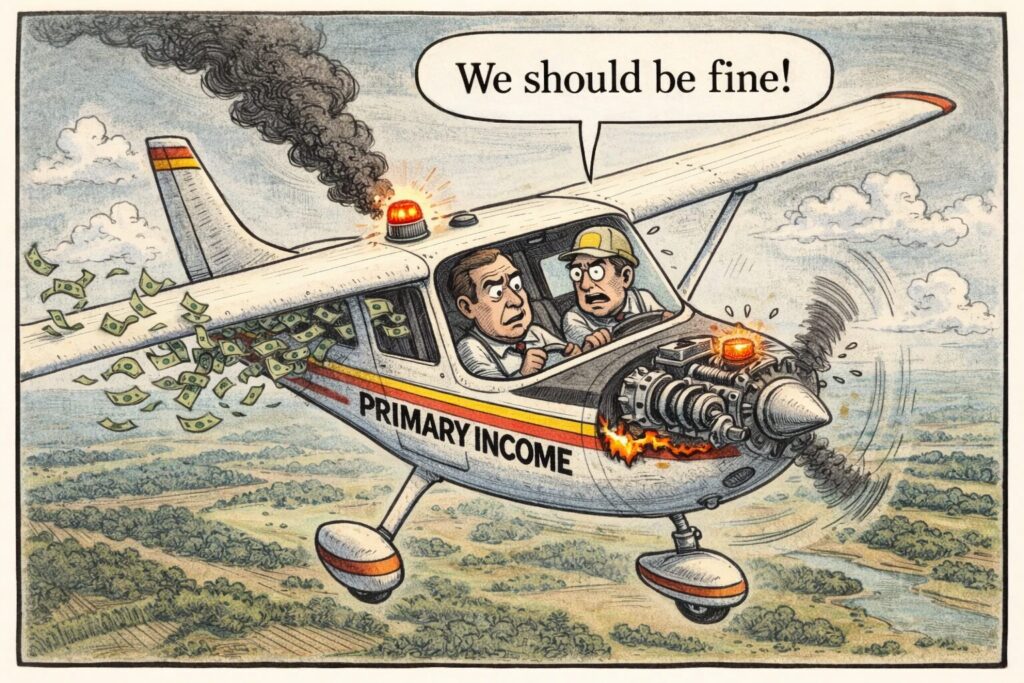
When Success Becomes a Single Point of Failure
There’s a quiet assumption that sits beneath most successful business owners:
“As long as the business is doing well, I’m secure.”
On the surface, that feels rational. You’ve built something real. It produces income. It may even be growing. People depend on you. The numbers look strong.
But underneath that confidence is a structural fragility that most owners don’t examine closely enough.
Your business is not your safety net.
It is your primary exposure.
And if it’s your only engine, you’re flying closer to risk than you think.
The Illusion of Stability
From the outside, a single thriving business looks like stability.
From the inside, it often feels like pressure.
Because everything runs through it:
- Your income
- Your lifestyle
- Your team’s livelihoods
- Your future exit
- Your identity
When one asset is carrying that much weight, it stops being a source of freedom. It becomes a point of concentration.
Not because the business is weak.
But because it’s carrying more than it was ever designed to.
A business is an operating system. It produces value, serves customers, and creates income. But it is also exposed—to markets, to people, to cycles, to your own capacity.
No matter how well you run it, it is still a single engine.
The Problem Isn’t the Engine. It’s Having Only One.
The question isn’t whether the engine is good.
The question is: What happens if it’s not?
A single-engine aircraft doesn’t give you optionality. It gives you dependency.
Now translate that to your life.
If your business slows down…
If a key person leaves…
If the market shifts…
If your energy drops…
What happens to everything else?
If the answer is “everything tightens”, then you’re not operating from security.
You’re operating from concentration risk.
The Fragility Few Dentists See Coming
This is especially true in professions built on precision—where income is directly tied to the reliability of your body.
I recently spoke with an an oral surgeon who built what most would consider an ideal career. Strong practice. Successful partnerships. Years of consistent income.
Then something subtle began to change.
A tremor in his hands.
At first, manageable. Then noticeable. Then undeniable.
Eventually, a diagnosis confirmed what he already knew: this wasn’t something that could simply be “pushed through.” There was no clear fix. He reached a point where he could no longer justify continuing to operate.
Not because the business failed.
Not because demand disappeared.
But because the one thing the entire model depended on—his hands—was no longer reliable.
“I personally wouldn’t want somebody operating on me if they had trouble keeping their hands still.”
In a matter of weeks, decades of active income stopped.
No gradual transition.
No phased exit.
No time to prepare emotionally.
Just a hard stop.
And what followed was not just financial recalibration—but a complete reframing of what actually mattered.
Because when the engine fails, everything that once felt non-negotiable suddenly becomes flexible.
That’s the reality of a single-engine life.
Not fragile because you’re irresponsible.
Fragile because you’re concentrated.
Why Success Makes This Worse
Early in the journey, risk is expected. You’re building, figuring things out, pushing through uncertainty.
But as success compounds, something subtle happens.
The business grows. Income increases. Complexity rises. Lifestyle expands. Commitments stack.
And instead of reducing risk, many owners unintentionally deepen it.
Because they never build a second engine.
They simply scale the first one.
More revenue. More responsibility. More dependency.
Which creates a dangerous dynamic:
The better the business performs, the harder it becomes to step away from it.
The Dual Engine Model™
Real security doesn’t come from a stronger primary engine.
It comes from having two.
This is the foundation of the Dual Engine Model™:
1. The Business Engine
This is what you’ve already built.
It generates active income. It creates opportunity. It may grow in value. It can become more efficient, more transferable, more resilient.
But it will always carry operational risk.
2. The Personal Wealth Engine
This is where most owners fall short.
This engine is designed to produce income independent of your business and your direct effort.
It is not tied to your daily decisions. It does not depend on your presence.
Its role is simple:
To carry your life when your business doesn’t.
Or more importantly—so your business doesn’t have to.
When you build a second engine, something shifts that most owners don’t anticipate.
It’s not just financial.
It’s psychological.
Because pressure changes when dependency changes.
- You make decisions from clarity instead of urgency
- You lead without carrying invisible fear
- You create space for your family, not just your work
- You stay engaged in your business because you choose to—not because you need to
The Hidden Cost of Waiting
Most owners delay building a personal wealth engine for understandable reasons:
- “I’ll focus on that after I scale a bit more.”
- “Once things stabilize, I’ll diversify.”
- “When I exit, I’ll figure it out.”
But waiting has a cost that doesn’t show up on a P&L.
Every year without a second engine is a year where:
- Your dependency remains intact
- Your optionality remains limited
- Your identity stays tied to performance
And life continues to orbit around a single point of failure.
This Is Not About Escaping Your Business
You don’t build a second engine to leave.
You build it so you’re no longer trapped.
So that if something changes—whether by choice or by force—you have room to respond without everything else collapsing inward.
And that’s the part most people miss:
You don’t feel the absence of a second engine… until the first one shuts off.
Building the Second Engine
The second engine is not built in a single move. It is designed—intentionally, steadily, and with a clear purpose: to reduce dependence on your time and your primary business.
It begins with a shift in how you think:
Not “How do I make more?”
But “How do I make my life less dependent on one source?”
From there, the work becomes practical:
- Create additional income streams. Not as distractions, but as deliberate layers of support. The goal is not complexity—it’s redundancy.
- Prioritize cash flow over speculation. Growth has a place. But income that shows up consistently—without your direct effort—changes how you make decisions.
- Reduce owner dependence in your business. A business that requires you for everything is not an asset. It’s a well-paying job. Build systems, elevate leadership, and create operational independence.
- Convert active income into productive assets. Don’t let income stop at consumption. Direct it toward assets that can eventually replace it.
- Shorten the gap between effort and optionality. The longer you wait, the longer you remain dependent. Start building while the primary engine is strong.
Most people define security as:
“My current engine is strong.”
A more accurate definition is:
“My life does not depend on a single engine continuing to perform.”
Final Thought
A single engine can take you far.
But it cannot protect you from the unexpected.
And it cannot give you the margin required to live fully present in the life you’ve worked so hard to build.
The goal is not to abandon your business.
The goal is to make sure your life can stand without it.
Build the second engine.
While the first one is still running.


